By Ruth Ellen Gruber
Vandals have damaged or toppled about 10 gravestones in the centuries-old Jewish cemetery in Puklice, near Jihlava. The cemetery is listed as a national cultural monument and had recently undergone restoration. Police are investigating the vandalism, which was discovered in the first week of January.
The Puklice cemetery, which includes about 100 gravestones, is one of the oldest in the Czech Republic, probably founded in the 15th century. The oldest legible gravestone dates from 1699. The small Jewish quarter in the village itself is largely intact, with the remains of a mikvah and a former synagogue/school (now a residence).
Jaroslav Klenovsky, who oversees Jewish heritage in Moravia for the Federation of Jewish communities, told Czech media that the vandalism was likely not a specifically anti-semitic attack, but the work of "young offenders."
You can see a video of the damage HERE.
Showing posts with label cemetery. Show all posts
Showing posts with label cemetery. Show all posts
Tuesday, January 17, 2012
Tuesday, July 26, 2011
Poland: New cemetery signage in Lutowiska and Starachowice
 |
| Lutowiska. Photo (c) Ruth Ellen Gruber |
By Ruth Ellen Gruber
I posted recently on the exemplary fashion in which Jewish heritage sites are cared for and put on local tourism and heritage itineraries in the remote village of Lutowiska in the far southeast corner of Poland.
There is even more signage point the way to the Jewish cemetery there now, thanks to the support of the Michael Traison Fund for Poland, the Community Office of Lutowiska and the Foundation for the Preservation of Jewish Heritage in Poland (FODZ) which erected a new information plaque and road sign.
Michael's fund, the FODZ and the Town Office of Starachowice also put up two new road signs marking the way to the local Jewish cemetery there (where I have never been).

Saturday, June 18, 2011
Poland -- the Chassidic Route: Baligrod
 |
| My car is parked at the entrance to the cemetery, pointing back toward the village. It was a bit tricky turning around. Photo (c) Ruth Ellen Gruber |
By Ruth Ellen Gruber
The village of Baligrod, about 20 km south of Lesko, is another stop on the Chassidic Route itinerary sponsored by the Foundation for the Preservation of Jewish Heritage in Poland (FODZ).
Jews lived here from the early 17th century and for much of the period between the 18th century and World War II they made up a majority of the residents. The synagogue and other buildings were destroyed in WWII.
The Jewish cemetery survives on a hill overlooking the town — a lovely spot with a beautiful view -- and the narrow, bumpy dirt road is clearly marked by signposts from the village. I drove up (as I didn't know how far it would be) but it would make more sense to park below and walk.
 |
| Photo: Ruth Ellen Gruber |
There are supposed to be about 200 stones here; the oldest legible date from 1718 and 1732. The Nazis used hundreds of gravestones to pave the market square -- they are believed still to be there, covered by asphalt.
The cemetery was restored in 2008, and the stones are in good condition — and there is even an incongruous red trash can for visitors to deposite rubbish (it was filled with used plastic water bottles) – but when I visited the grass and weeds were chest-high , in sore need of cutting. The grass totally obscured some of the stones -- I tried to see as many as I could, but I know I didn't see them all.
 |
| Photo (c) Ruth Ellen Gruber |
Still, I found many beautifully carved stones, with a variety of candlestick shapes on women's stones, ranging from crude but delicate incised images to more elaborate styles, some featuring candlesticks flanked by birds. See more candlesticks stones at my candlesticksonstone.wordpress.com site.
 |
| Photo (c) Ruth Ellen Gruber |
Someone had clearly visited a short while before I did, though, as there were narrow paths tromped through the grass, and someone had piled stones and pebbles on many of the gravestones.
 |
| Photo (c) Ruth Ellen Gruber |
Wednesday, June 15, 2011
Poland -- the Chassidic Route: Lesko
 |
| Former Synagogue in Lesko. Photo (c) Ruth Ellen Gruber |
By Ruth Ellen Gruber
The last time I had been in Lesko was in 2006, when I was updating my book Jewish Heritage Travel -- but also attending the annual biker and country music festival held there, "Moto Country Piknik." It was a wild night full of black leather-clad beer-drinkers, heavy metal chrome, and Polish country acts, most of whose names I didn't get.
 |
| Lesko Moto Country festival, 2006. Photo (c) Ruth Ellen Gruber |
Five years later, on the Jewish heritage front, I found little changed...
The imposing synagogue, just off the main market square, dates from the mid 17th century. It is the only one of five prayer houses to survive World War II. It was devastated during the war and rebuilt in the 1960s -- the reconstruction added baroque gables (which a booklet on sale at the synagogue said had been removed in the 19th century). That on the front facade frames the depiction of the Ten Commandments. The reconstruction also extended the height of the tower so that it now extends above the roof level.
All in all, I find it a very beautiful and impressive building -- and, importantly, there has long been separate signpost outside identifying it as a former synagogue and describing the history: before World War II, nearly two-thirds of the town population was Jewish. In the entry hall there are several plaques listing the names of hundreds of Lesko Jews killed at the Belzec death camp in 1942.
 |
| Memorial to Lesko Jews at Belzec. Photo (c) Ruth Ellen Gruber |
The synagogue is now used as a gallery displaing and selling local arts and crafts. Five years ago I bought there a wonderful naive carving of the late Pope John Paul II, wearing red shoes and with his head surrounded by angels.
 |
| Inside the synagogue gallery. Photo (c) Ruth Ellen Gruber |
Each time I've visited the gallery, I've found a refreshing lack of kitschy carved Jewish figures and paintings on sale -- such as those so prevalent in Krakow and Warsaw... but one of the local artists still did utilize the "Jew and money" stereotype in a rather outrageous manner! That's real money clutched in their hands!
 |
| Photo (c) Ruth Ellen Gruber |
The Jewish cemetery in Lesko, founded in the 16th century, is one of the oldest and most historically important in Poland. It is vast, and rises up a steep hill, just down the road from the synagogue. The oldest stones are at the bottom, by the entrance -- massive slabs with vividly carved epitaphs but no other decoration. Here is where the tour groups stop -- a Polish tour group was visiting this time when I entered.
 |
| Photo (c) Ruth Ellen Gruber |
The higher you go the more, and more recent, and more vividly carved stones there are. But also -- at least in early summer -- the more overgrown and untended do you find them..... it is a real wasteland; I have to say, I felt both glad to see people (like the tour group) visiting, but rather lonely and depressed that so much of the cemetery was a jungle. And this comes from someone who has seen endless overgrown Jewish cemeteries in Eastern Europe! I think the contrast of the "known" and "unknown" -- the "remembered" and the "forgotten" -- just got to me.
 |
| Photo (c) Ruth Ellen Gruber |
I can't put it any better than a post I have linked to before -- a description of the Lesko cemetery on the riowang.blogspot.com site.
Thursday, June 9, 2011
Hungary to Poland trip -- Lutowiska!
 |
| View of Lutowiska from Jewish cemetery. Photo (c) Ruth Ellen Gruber |
One of my aims in the southeastern corner of Poland was to explore some Jewish heritage sites for the first time -- as well as revisit some that I had been to previously to update my information on their status and condition.
One of the first-time places was the hamlet of Lutowiska -- way down in the triangular southeastern tip of the country that pokes between Ukraine and Slovakia, very close to the Ukrainian border. Pretty far, far away..... When borders were different, though, tt was once a major trading center, with a large Jewish population. According to a Yizkor book entry on Lutowiska, Jews were the majority population from the late 19th century.
Here's information from the town web site:
The name Lutowiska comes from the Russian word „letowyshche” designating a place where cattle and sheep were grazed in summer. The village was set up in the 16th century according o the Wallachian law in estates that then belonged to the Stadnicki family. The village was first referred to in 1580. The village was located on the intersection of busy trade routes from Sanok to the Tucholska Pass and further to Transylvania and from Przemyśl through the Beskid Mountains or Użock Pass to Użhorod. There was also a local route to the East through Turka to Drohobycz. Such a place encouraged the location of a town. Thanks to the efforts of Ludwik Urbański Lutowiska was granted a charter at the beginningof the 18th century. In 1742 King August III granted the town a privilege to hold ten big fairs a year (by comparison Sanok and Lesko only held two big fairs a year). In the 19th century the big fairs in Lutowiska were famous throughout Europe. People chiefly traded in oxen that were grazed on high-elevation meadows (poloninas). They were grey, long-horned cattle called Hungarian, willingly bought even by merchants from Western Europe. During thebig fair the whole Lutowiska was packed with cattle, a few thousand animals were here at a time. Lutowiska’s centra consisted then of two adjoining market places surrounded by wooden houses, which mainly belonged to Jews, a majority of the town’s population. Lutowiska lost the status of town in 1919, though it remained the region’s significant trade and administrative centre until the Second World War. The census of 1921 discovered 261 houses inhabited by 2125 people. In 1939 the settlement already had about 3500 inhabitants. In June 1942 Gestapo officers from Ustrzyki Dolne shot ca. 650 local Jews. They also burnt the synagogue and Jewish houses, practically all the wooden buildings in Lutowiska. Between 1945 and 1951 Lutowiska was within the Soviet borders, the name was changed to Shevchenko. At the end of 1951 a mere 28 families lived there. Resettlers from the Sokal and Hrubieszów regions mainly moved to the deserted houses. The village only reverted to its original name after a few years. In 1951 Lutowiska became home to communal authorities.
I had been told that there was a Jewish cemetery here, but that it was outside the village; I would have to ask, I was told, but people would know.
In fact, there is a beautiful, and beautifully maintained, Jewish cemetery here, as well as the ruins of the synagogue -- and I was delighted to find that local authorities have included both in a well organized touristic/educational route in and around the town that focuses on the three cultures that before WW2 coexisted here -- Jews, Poles and Ukrainians. The itinerary is aimed at bringing back awareness of destroyed local history (Holocaust as well as post-war expulsions and population and border shifts) and also highlight the landscape and environment.
 |
| Sign of Three Cultures route outside entry to Jewish cemetery. Photo (c) Ruth Ellen Gruber |
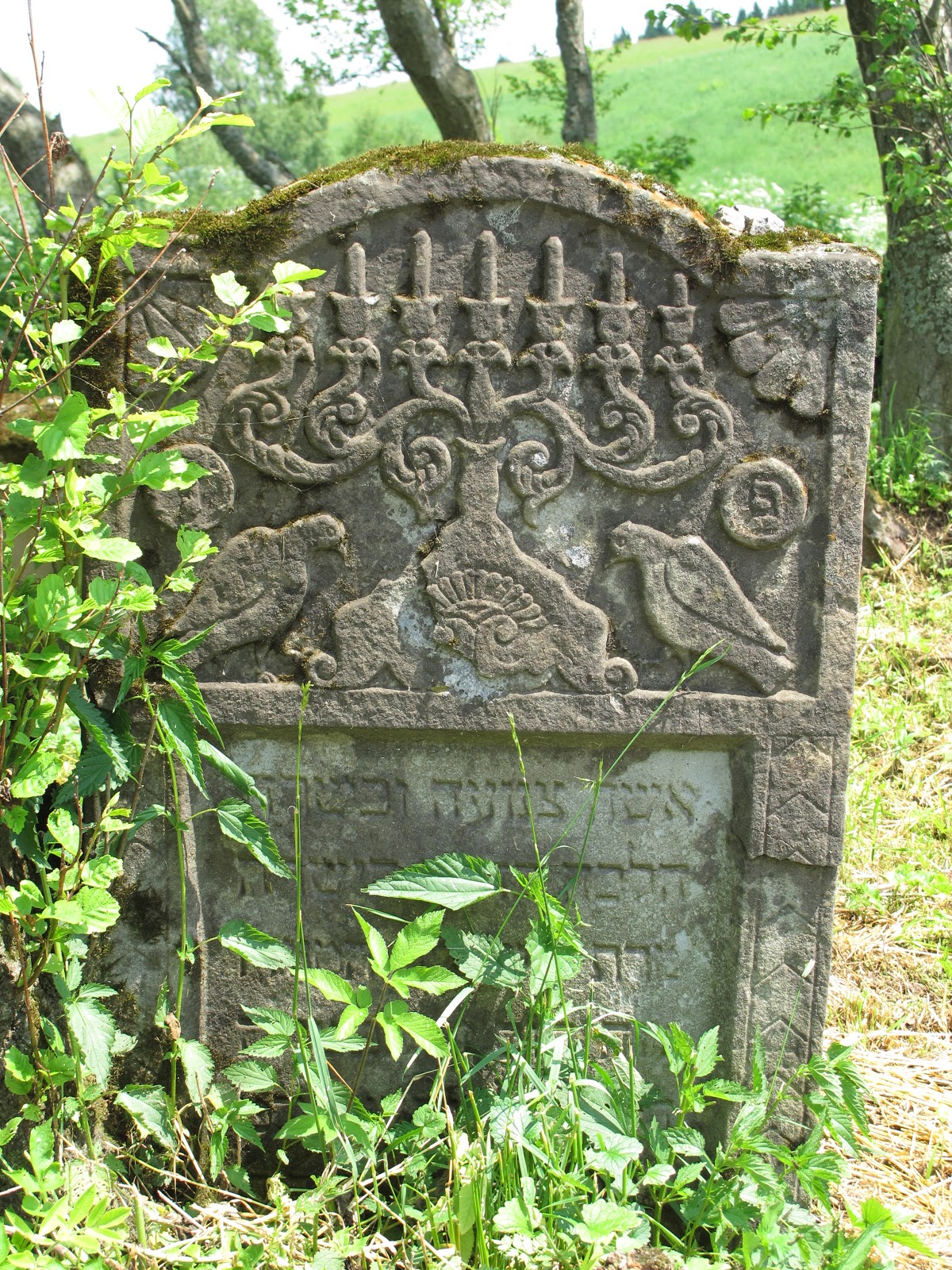
The cemetery is enclosed by a rustic fence, and the weeds and grass are cut. There are some dozens of gravestones, some with fairly elaborate carving; many tilted, some eroded -- I was able to document a lot of women's tombstones, for my (Candle)sticks on Stones project, showing a variety of carved versions of candlesticks.
Some of the carvings were very reminiscent of the carving style in Busk and other places across the border in what is today Ukraine.
 |
| Photo (c) Ruth Ellen Gruber |
 |
| The carving on this stone reminds me of that across today's border in Ukraine. Photo (c) Ruth Ellen Gruber |
|
| Photo (c) Ruth Ellen Gruber |
 |
| Replica of the Greek-Catholic church Photo (c) Ruth Ellen Gruber |
Wednesday, June 8, 2011
Hungary to Poland trip Part I -- a Jewish cemetery uncovered....
 |
| Revealed on the road side. Photo (c) Ruth Ellen Gruber |
I'm beginning to post material from my recent road trip to Hungary and Poland; it was somehow difficult to get things online when traveling....
My itinerary took me from Budapest to Sanok and other towns in the far southeast corner of Poland, and then to Krakow. Most of the route through Hungary is four-lane motorway, but from Miskolc north to the border with Slovakia it's still a two-lane highway.
The first time I recall driving this way was in 1992, when I was researching my book "Upon the Doorposts of Thy House: Jewish Life in East-Central Europe, Yesterday and Today." One of the chapters of that book is a long essay, "Wine Merchants and Wonder Rabbis" about the links that connected northern Hungary and southern Poland -- wine going north, Hassidism going south.
At that time, the only person I encountered who remembered the existence of the Jewish cemetery of Méra, a village in northern Hungary in the road to the Slovak border, was a malodorous old drunk, who got in the car and guided me there. I found the broken frame of a gate and a few eroded tombstones imbedded in a thick wall of brush just off the side of the main road.
The last time I had driven that way, a few years ago, I hadn't been able even to make out where the cemetery was, it was so overgrown. There seemed to be nothing. I feared it was totally lost -- and with it, the memory of the Jews who had lived there.
So this time, I was quite surprised to find that the cemetery had been cleared of brush, bushes, under- and overgrowth, with the stones fully exposed. In fact, I was astonished! Even the grass/weeds had been freshly cut! (I'm not sure, though, who has carried out the work or when it was done.)
 |
| Photo (c) Ruth Ellen Gruber |
What was revealed, however, was the story of death and vandalism as well as remembered life... some of the stones had been broken or smashed...., but the fragments had been gathered and stood together.
 |
| Photo (c) Ruth Ellen Gruber |
But...regardless -- there they were! Clean, cleared, exposed, not submerged any more out of sight out of mind; revealed for all to see!
Tuesday, January 18, 2011
Poland --evocative blog posts about Lesko cemetery (and synagogue)
 |
| Lesko Jewish cemetery, 2006. Photo (c) Ruth Ellen Gruber |
By Ruth Ellen Gruber
I have just come across two very detailed blog posts about the synagogue and ancient Jewish cemetery in Lesko, in the far southeastern corner of Poland.
Both posts, on http://riowang.blogspot.com, are very informative and richly illustrated with photographs -- they make me wish I had spent more time in Lesko when I was last there, in 2006, updating JHT.
 |
| Lesko synagogue, 2006. Photo (c) Ruth Ellen Gruber |
Monday, July 12, 2010
Poland -- Piotrkow Trybunalski cemetery photos
I have posted a photo gallery of images of the Jewish cemetery in the Polish town of Piotrkow Trybunalski on the web site of my (Candle)sticks on Stone project. They show women's tombstones and a variety of candlestick images, including broken candles, as well as mythical animals and other imagery and iconography.
Wednesday, June 16, 2010
Bosnia -- Jewish cemetery in Zenica
If people know anything about the Jewish history and sites of Bosnia-Hercegovina, it is about Sarajevo, where there is a wealth of fascinating attractions.
Here is link to a collection of photos I have run across about the Jewish cemetery in Zenica, a town in the center of the country, northwest of Sarajevo, which has been cleaned up.
Here is link to a collection of photos I have run across about the Jewish cemetery in Zenica, a town in the center of the country, northwest of Sarajevo, which has been cleaned up.
Wednesday, May 12, 2010
Poland -- tombstones recovered
The Foundation for the Preservation of Jewish Heritage in Poland reports that more than 60 Jewish tombstones used during the World War II to pave a courtyard of the Gestapo prison in the town of Mogielnica, south of Warsaw, have been discovered, unearthed and secured. After the renovation of the Jewish cemetery in Mogielnica, the stones will be returned to the cemetery grounds
Tuesday, February 23, 2010
Poland -- old Jewish cemetery in Przemysl returned to Jewish ownership
An article in the Jerusalem Post on the return of a descrated, centuries-old Jewish cemetery to Jewish ownership. Nothing remains visible at the site except the broken frame of a gate.
The cemetery, located in the city of Przemysl, near Poland's border with the Ukraine, dates back to the 16th century and served local Jews, as well as those in nearby towns such as Jaroslav, Pruchnik, Kanczuga and Dynow, for hundreds of years.
But the Przemysl municipality, which took over the site following the end of World War II, resisted calls to return it.
At a meeting last week, however, Poland's government-backed Regulatory Commission, which resolves claims regarding Jewish communal property, instructed city officials to turn the cemetery over to Jewish control.
The decision marks a triumph for the Warsaw-based Foundation for the Preservation of Jewish Heritage in Poland, and especially for its president, Monika Krawczyk, who led the effort in recent years to recover the graveyard.
Wednesday, January 13, 2010
Poland -- Fascinating article on epitaphs in Bialystok Jewish Cemetery

Tomasz Wiesniewski opens the gate to the Bagnowka Jewish cemetery in Bialystok, 2006. Photo (c) Ruth Ellen Gruber
by Ruth Ellen Gruber
The online "Jewish Magazine" publishes a fascinating article by the scholar Heidi M. Szpek about the epitaphs in the Bagnowka Jewish Cemetery in Bialystok, Poland.
Called "In the Bloodshed of Their Days," it explores how tombstone epitaphs provide a vivid picture of the people buried there, and thus shed light on the life of the community -- both the good times and the bad.
As I translated each of this cemetery's inscriptions, I read of the character and qualities of the Bialystoker Jews, of "perfect and upright men" and "modest and God-fearing women". On their tombstones are also words of praise for great rabbis, scholars, and charitable women. Old age is recorded as a triumph, especially in the case of an Abraham son of Israel who lived to be 102 years old. What history Abraham must have seen and experienced from 1830 to 1932, the century and more of his life! (Image 2) Occasionally, the lesser qualities of the deceased are remembered, as one father wrote of his daughter: "Her mouth ceased from (its) evil tongue" – she gossiped!
These inscriptions also hold details that were sadly normal to life in a world a century ago in Bialystok, Poland. Inscriptions remember women who died in childbirth, especially in the cold winter months, women who died before they could marry, and a man who barely experienced the joy of fatherhood before his untimely death. And then there are the tombstones of children. Perhaps the most heart wrenching inscription is that of three sons – Chaim Lejb, Shalom Shechna and Israel Abraham, aged eight, six and four, who died in a fire in March of 1908! How did their father, Asher, and their mother endure this loss? Such deaths, though sad, are not unique to Bialystok; they were part of life without the comforts of the contemporary world.

Photo (c) Ruth Ellen Gruber
Szpek, a Professor of Religious Studies and Philosophy at Central Washington University (Ellensburg, Washington), is currently writing a book on the Jewish epitaphs from Bialystok. She spent three years translating all the epitaphs in the Bagnowka cemetery, the only Jewish cemetery to remain in Bialystok. Over the years she has worked with Tomasz Wisniewski, who has dedicated the past quarter century to documenting Jewish heritage in eastern Poland and who has been my own guide to Bialystok.
In Bialystok, Poland's Jewish cemetery on Wschodnia Street, the black Memorial Pillar that stands at its center is a blatant visual reminder of hatred vented in the past. The nearly 50 tombstone inscriptions that speak of "the bloodshed of the days" also bear subtle witness to Jewish persecution in the years 1905 onward. But of what value is this knowledge? The answer no doubt depends on the individual. For some people these tombstones might bring awareness that this entire cemetery - not just the tall, black Memorial Pillar – is a memorial to the "bloodshed of the days" in Bialystok's past. For others the knowledge imparted by these inscriptions fosters remembrance of the very personal world of Bialystok Jewry, a world at times gentle and loving, a world at times sad and violent. But for me, in particular, these horrific phrases, combined with a woman's name, a father's name, a child's name, with words of love mixed with words of grief, and a date, remind me of specific incidents in Bialystok's past. Together all these words also remind me that I am not simply translating words cut into stone. Rather as I translate I feel – if only for a moment – a touch of the anguish experienced by those of Bialystok's now 'lost' Jewish community, those perceived as 'the other' by past generations of Russians, Poles and Germans. In this brief moment of my anguish, an indissoluble desire is implanted in my mind and engraved on the tablets of my heart - that past hatred may not bequeath to us a future legacy of hatred and anguish.
Read full article

The memorial to the 1905 pogrom, Bialystok cemetery. Photo (c) Ruth Ellen Gruber
Tuesday, January 12, 2010
Ukraine -- Report on Cemetery Clean up and exhibit at Sniatyn
More on Ukraine -- Check Sam Gruber's blog for a long post and photographs about an "archeology of memory" project this past summer organized by the Center for Urban History in L'viv to clean up the Jewish cemetery in Sniatyn, rescue tombstones that were used to pave a courtyard, and stage an exhibition.
The Center's web site reports:
The Center's web site reports:
The goal of the project was to return the attention of the inhabitants of Sniatyn to the multi-national and multi-religious heritage of their city with the help of the two week program of a volunteer camp made up of youth from Ukraine, Poland and Germany. The program included fixing up and recording the architectural cemetery ensembles of the city. Concurrently the camp become an opportunity for participants of the volunteer group to become acquainted with the heritage, as well as contemporary life of Sniatyn. The work of the volunteers focused on two cemeteries in Sniatyn - Jewish and Christian, which are found not far from one another. The Christian cemetery is still used as a place of ritual events. The Jewish cemetery is in a state of neglect and ruin, and gravestones are being destroyed by spreading tree roots. Both cemeteries are monuments to the culture and history of the city, witnesses of the life and death of Sniatyn’s past inhabitants.Nineteen young people took part in in the two week project at the end of July and beginning fo August.
The project was realized by the Centre for Urban History within the framework of the program "Memoria", which was initiated by the foundation "Memory, responsibility and future" and was led together with the Stefan Batory Foundation. The goal of the program is to inspire young people to look for traces of shared culture and history in the border territory. The geographical focus of the program is Central and Eastern Europe, where for centuries people from different cultures, religions and languages co-existed. The Second World War and the Holocaust, deportations and changing borders after 1945 almost completely destroyed the diversity of these territories. That is why, within the framework of the "Memoria" program, events are organized with the participation of young volunteers from Germany, Poland, Czech Republic, Lithuania, Russia, Belorus and Ukraine, which are aimed at the preservation of historical monuments, acquaintance with different aspects of border area history and culture and formation of contacts with the inhabitants of these populated points, where the camps take place.
Monday, November 9, 2009
Lithuania -- More on Kalvarija Cemetery Project
More information has been posted about Ralph Salinger's project to record the information on the tombstones in the Jewish cemetery in Kalvarija, Lithuania. You can find it by clicking HERE.
Monday, September 21, 2009
Romania -- Jewish cemetery in Gura Humorului
By Ruth Ellen Gruber
I've begun to post some YouTube videos of Jewish cemeteries in northern Romania that I am documenting for my (Candle)sticks on Stone project, which examines the way that women are represented in Jewish tombstone art.
The first video is of the cemetery in Gura Humorului, a little town in the heart of the painted monastery country -- two wonderful medieval monasteries, Humor and Voronets, are nearby. To me, the beautiful Jewish tombstones are in perfect harmony with the wonderful paintings on the monastery walls: touriststs visit the monasteries, however, and few people set foot in the cemetery.
I've begun to post some YouTube videos of Jewish cemeteries in northern Romania that I am documenting for my (Candle)sticks on Stone project, which examines the way that women are represented in Jewish tombstone art.
The first video is of the cemetery in Gura Humorului, a little town in the heart of the painted monastery country -- two wonderful medieval monasteries, Humor and Voronets, are nearby. To me, the beautiful Jewish tombstones are in perfect harmony with the wonderful paintings on the monastery walls: touriststs visit the monasteries, however, and few people set foot in the cemetery.
Wednesday, September 16, 2009
Romania -- Botosani
 Botosani. Entrance to old Jewish cemetery. Photo (c) Ruth Ellen Gruber
By Ruth Ellen Gruber
A few months ago, I posted on the desecration of tombstones at the Jewish cemetery in Botosani, Romania. I visited the cemetery last week as part of my (Candle)sticks on Stone project to document the representation of women in Jewish tombstone art in northern Romania's Bucovina region.
The cemetery is vast, and though the newest section is well maintained (and still used by the small Jewish community) the rest of the cemetery is almost inpenetrable.
 Photo (c) Ruth Ellen Gruber
It is in the newer section of the cemetery, just on the edge of the overgrown part, that the vandalism took place: a number of smashed and toppled stones still lie there.
 Photo (c) Ruth Ellen Gruber
I had wanted to go back to Botosani because I had been so impressed by the distinctive carvings on the (men's) tombstones I had seen three years ago -- vigorous lions, stags and other animals carved in a style that was almost reminiscent of art deco! I had seen a number of these stones in a clearing, down a path from the newer section, and I wanted to see if the same artist/stone mason had also carved candlesticks on women's stones.
This time I found the path, but in three years, weeds, brush, bushes and even saplings have grown up, once again hiding many of the stones that had so impressed me and making it very difficult to take pictures!
 Botosani. Photo (c) Ruth Ellen Gruber
I did discover some extremely beautiful and evocative candlesticks -- quite different from those in other towns. But it was so dark and so overgrown that I didn't manage to get the images I had hoped for...Still...
 Botosani. Photo (c) Ruth Ellen Gruber
Tuesday, September 8, 2009
Romania -- More Family History Discovery Travel
 At the tomb of my great-great grandmother (my Grandma Becky's grandmother) Chaya Dvoira Herer Halpern, in the Radauti Jewish cemetery. She died Feb. 22, 1905 at the age of 69)
By Ruth Ellen Gruber
My cousins all left, but I have stayed in Radauti for a couple more days, continuing my photo documentation for my (Candle)sticks on Stone project -- and also carrying out some more family history research -- and making discoveries, some of them even rather surprising: the grave of my great-great grandmother; the house where she lived; questions about my grandmother's birth date and circumstances; even the date of my great-grandfather Anschel's death.
I'm not obsessive about genealogy by any means, and in fact -- despite the fact that I have visited my great-grandmother Ettel's grave on several occasions over the year (click HERE to see the progression) -- I have never really looked into our family history in a serious way.
But our session at the town hall with Dorin Frankel last week, and our subsequent trip to Vicovu de Sus and discovery of what we believe was the house where our great-grandfather Anschel lived in 1880, left some loose ends that needed tidying, or at least some questions that I wanted to try to answer. I couldn't leave town without at least trying to resolve them.
One of these was a street address in Radauti -- strada Larionescu 20 -- that my second cousin, Rae Barent, who has made a serious effort a tracing family history, sent -- and which was confirmed by the records I looked at during a second session with Dorin at City Hall yesterday. This was the address where my great-great grandmother, Chaya Dvoira Herer Halpern, lived.
I also found out, by correlating the information found in the archives (and some sent by Rae) with info at the Radauti Jewish heritage web site (lots of cheers to the people who put together the amazing documentation material on the cemetery) that Chaya Dvoira, the daughter of Moshe (Moses) Mortko and Ruchel Hörer, died Feb. 22 1905 at the age of 69 -- the registry gave her cause of death as "old age" -- was buried in the Radauti Jewish cemetery. It also described her as single, not a widow (which probably means that her marriage, like that of her daugher Celia -- Zirl -- and David Rosenberg, my grandmother's parents, had not been formally registered with the city officials. From the registry, I could see that this was a fairly common practice.)
This morning, armed with the plot and row numbers I found on the Radauti cemetery web site for a "Chaya Dvoira daughter of Moshe Morko" who died in 1905, I returned to the Jewish cemetery. Mr. Popescu showed me the row -- and I entered the tilting forest of stones, again crunching through the undergrowth in my boots. I had to scrutinize the Hebrew epitaphs on each one, testing my basic Hebrew to its limits. After half an hour or so, there it was: I could read the name. The stone is smaller than some of the others, but it has the typical braided candlesticks and hands raised blessing the flames, beautifully carved. And there are still traces of red and green paint. I pulled away a strand of stray vines: not sure what, if anything, I actually felt. Glad to be there; cognizant of distance, time, realms; the passing of time and history. Wishing the others could have been there too. Wondering what she looked like!
 Amid the forest of stones, a piece of my distant past. The small stone on the left. Photo: Ruth Ellen Gruber
My cousins and I had tried to find Larionescu street, but in today's city there is no record of it. Dorin Frankel, however, knew where it was -- near the synagogue -- and he walked with me there after our session yesterday morning at City Hall. The street name has been changed, but the house is still there -- nicely maintained and modernized inside.
 Looking into courtyard of house at Larionescu 20.
 At Chaya Dvoira's pump. Strada Larionescu 20.
Other information I came across in the City Hall registry books, during a couple of hours there with Dorin Frankel:
-- my great-grandfather Anschel Gruber (the one who lived in the house we found in Vicovu de Sus) died in 1914, possibly in September of that year. But his death wasn't recorded in the registry until 1920. The book says he is buried in the Radauti cemetery.
-- There is no birth record for my grandmother, Rebecca Rosenberg, who I thought was born in about 1895.... BUT there is a record of the birth to Rebecca's parents, Zirl (later Anglicized to Celia) Halpern and David Rosenberg (not officially registered as married at the time), in Oberwikow, or Vicovu de Sus of TWINS on Sept. 25, 1899 -- including a daughter Rifka (Rebecca in Yiddish) and a son, Jüdel, whose bris was on Oct. 2. The family left for the States in about 1906, but Jüdel's death is included in the Radauti City Hall registry (though added in 1920), indicating he must have died very young.
Sunday, September 6, 2009
Romania -- Occupational Hazards
 Siret -- new cemetery from middle cemetery. Photo (c) Ruth Ellen Gruber
By Ruth Ellen Gruber
Sept. 6, 2009
I tromped around in the Jewish cemetery in Siret, Romania (on the border with Ukraine) this morning: as I already knew, but recognized yet again, this is not the best time of year to be trying to research and/or photograph neglected Jewish cemeteries....In Radauti, a few days ago, I got hot and sweaty clumping through the grass and weeds in a cemetery that is actually very well maintained (by the gold-toothed Mr. Popescu, who also provides water in a plastic bottle to wash hands with, according to tradition, when leaving the cemetery. He pours it three times over your fist. A woman who may or may not be Mrs. Popescu will open up the tall domed ceremonial hall and draw out slim candles, if you ask.)
At Radauti, I was bothered (so to speak) by the spider webs that looped across the spaces between the tombstones and also draped from the overhanging branches to the stone. More so than the webs, I was bothered by the big fat brown spiders that sat amid them, waiting, or occasionally scutting up the slim threads when they felt a human presence.
When I got back from photographing the stones in Radauti, actually, several hours later, I was perturbed to find, crawling on the brilliant white of my hotel bed linen, a little black tick....Shades of the fear of lime disease (from which a friend of mine in Hungary has been suffering.) Also memories of how I was bitten by a tick when visiting the old Jewish cemetery on the Lido of Venice, some years ago. I had to get a tetanus shot and take the dead tick to the health service for analysis. An interesting way to see untouristed parts of the city.
At Siret, there were no spiders. But there was plenty of tall grass that I swathed through -- thank goodness for my cowboy boots. They saved my legs 3 years ago, when I tripped and fell over a hidden stone in the cemetery of Sadagora, Ukraine.
This is the third time I've been to Siret, whose three cemeteries are among the most impressive. I also love the way you can discern the hand of individual artists -- there are "templates" of style, arrangements of elements as well as individualistic style of carving.
 This has always been one of my favorite stones in Siret. Photo (c) Ruth Ellen Gruber
The tall grass and other undergrowth made it difficult to get to many if not most parts of the special "middle" cemetery; but it was Sunday, and standing there, swimming through the weeds, recording the physical reminders of so many Jews who once lived here -- the archetypical "Tribe of Stones" -- I could hear the Sunday service the one of the local churches, broadcast over a loudspeaker.
Thursday, September 3, 2009
Romania -- Family history
 Great Synagogue, Radauti. Photo (c) Ruth Ellen Gruber
By Ruth Ellen Gruber
I'm too tired to write much tonight. Suffice it to say that the Cousins and Candlesticks tour had its genealogical high spots.... We visited the tomb of our great-grandmother, Ettel Gruber, in the Jewish Cemetery in Radauti (where I have been three times before since 1978).
 Photo: Doru Losneanu
Thanks to the good efforts (and contacts) of Doru Losneanu, Mr. Dorian Frankel helped us go through records at the Radauti Town Hall. We found the marriage registry for the parents of both our Grandfather, Ephraim/Frank (that is, Anschel Gruber, widower, aged 34 and Ettel Lecker, single, aged 19) in 1880 and our grandmother, Rebecca Rosenberg (David Rosenberg and Celia Halpern) in 1902.

This also gave us the address in the village of Vicovu de Sus where, it seems, Anschel Gruber lived at the time of his marriage.
We drove to Vicovu de Sus, about 1/2 an hour's drive, up at the border with Ukraine -- there is a border crossing there for local people. It's a village strung out for seeming miles along one road... with the help of a couple of very nice local policemen, we found what we believe was the house, an old wooden farmstead, set down a dirt track, amid cornfields, well of the road (apparently an elderly woman, as well as a barking dog, lives there -- and she does have a satellite dish...).

Monday, June 22, 2009
Spain -- Cemetery Controvery in Toledo Resolved
Philip Carmel, the executive director of the Jewish cemetery preservation organization Lo-Tishkach reports a successful conclusion to the controversy over about 100 graves dug up from the medieval Jewish cemetery in Toledo, Spain to make way for the expansion of a school that already occupies part of the cemetery site.
All the bones were reburied in their original grave sites at a ceremony on Sunday.
As Sam Gruber and I have noted in earlier blog posts, the Toledo construction was halted earlier this year after heated protests, including demonstrations outside Spanish embassies.
Phil makes clear that the government, local authorities and Jewish organizations cooperated to work out a satisfactory solution to the problem.
He writes:
All the bones were reburied in their original grave sites at a ceremony on Sunday.
As Sam Gruber and I have noted in earlier blog posts, the Toledo construction was halted earlier this year after heated protests, including demonstrations outside Spanish embassies.
Phil makes clear that the government, local authorities and Jewish organizations cooperated to work out a satisfactory solution to the problem.
He writes:
I am pleased to inform you that yesterday, Sunday June 21, saw the reburial of all the bones removed from the medieval cemetery in Toledo. The remains were buried on site in the actual graves from which they had been removed. This was achieved after protracted negotiations which only reached fruition last Thursday in Madrid at which point we decided not to publicise details of the reburial until after it had concluded.
This remarkable and historic solution brings a satisfactory conclusion to a chapter which has seen a tremendous degree of solidarity and cooperation on the part of the Spanish government and the local Jewish federation and a willingness to work together with the Conference of European Rabbis and the Committee for the Preservation of Jewish Cemeteries in Europe to achieve an amicable solution within the boundaries of Halachah.
At all times, we have insisted that the remains of these Toledo Jews should be buried in their chosen resting place and not transferred to another site. We are highly satisfied that the moving ceremony which took place yesterday in the presence of local Jewish leaders, heads of the regional authority of Castilla la Mancha, and the president of the CPJCE, Rabbi Elyokim Schlesinger has given the correct conclusion to our work.
I want to also state for the record our deep gratitude for the unstinting and dedicated work of Ambassador Ana Salomon and the Spanish Ministry of Foreign Affairs in assisting us to find a solution to this matter in the face of unwarranted protests and misinformation directed against the Spanish government and the local Jewish Federation.
I hope that our work to save this historic cemetery in Toledo will prove to be a prototype for how governments, local Jewish communities and representative Jewish organisations can work together for the benefit of preserving these cemeteries in Europe.
Subscribe to:
Posts (Atom)