Showing posts with label Romania. Show all posts

Sunday, September 28, 2014

Nearly 25 years later, revisiting the old question : Should old synagogues in Eastern Europe be restored?

Exterior Rumbach st. synagogue, Budapest, December 2011. Photo © Ruth Ellen Gruber


I'm crossposting this item that I put up today on Jewish Heritage Europe, the web site that I coordinate as a project of the Rothschild Foundation Europe. It looks back over the past quarter century of Jewish heritage preservation and priorities -- showing that despite progress that has been made and mind-sets that have changed, much still resonates:


Writing in September's Moment Magazine, Phyllis Myers posed the old question: should old synagogues in eastern Europe be saved?

Her answer — and mine — is, of course, a resounding YES.

It is important to remember, however, as Myers points out, that this answer was not self-evident — or even all that widely held — when she, and others involved in the field, first posed the question a quarter of a century ago, after the fall of the Iron Curtain.

Myers first did so in a long article, also in Moment, published in 1990, called “The Old Shuls of Eastern Europe: Are They Worth Saving?”

It’s worth reading again today to get a sense of the situation on the ground — and in people’s mind-sets — back then, just as the movement to document and restore Jewish built heritage in eastern and central Europe was getting under way. In a sense, her article represented a sort of blueprint for what could — and should — be the preservation priorities for the coming generation.

As more restoration takes place, the need for integrity and creativity in communicating the many dimensions of the Jewish experience will grow. The answer is not just a series of plaques on the buildings. Or more exhibit cases of Jewish ceremonial objects. Or lists of famous Jews. We must strive to evoke a unique encounter between visitor and place. We need to remember that as time passes a n d travel increases, visi­tors will want to know more about how Jews lived as well as how Jews died.

A quarter of a century later, the essence of what she wrote still holds true. The priorities she outlined are still priorities that should be addressed, and — despite the many successes and great strides accomplished — her message and the concepts she framed still have a powerful resonance. Indeed, one of the synagogues whose deteriorated condition she specifically mentioned in 1990 – the Rumbach st. synagogue in Budapest — still languishes in a sorry state despite sporadic efforts to restore it.

   
Interior of Rumbach st. synagogue, 2011


“We preserve—buildings and places, the simple and the awesome—for many reasons,” Myers wrote in 1990.


We preserve to remember. For decades, Jewish preservation in Eastern Europe has focused primarily on places of death. Chasidim have tended cemeteries, especially the graves of Tzadikim (charismatic lead­ers), while other Jews have ensured that death camps remain as witnesses to a story that could otherwise become myth.
But preservation means Jewish life as well as death. When we walk in the footsteps of our forebears, contemplate their lives, stand in the places where they lived—and were betrayed—powerful linkages occur between their lives and ours.

We preserve to learn. American archi­tectural historian Carole Herselle Krinsky writes, “Synagogues…reveal especially clearly the connections between architecture and society.” Clues to self-perceptions of Jews over the centuries, the evolution of faith and culture and relations with Gentile neighbors abound in the shapes, materials, designs and settings of synagogues. Did a community choose Gothic or Moorish ar­ chitecture, site its synagogue on the street or set it back off a courtyard, retain a sepa­rate entrance for women or build a gallery in the main hall? Did it raise a dome high or low in the community’s skyline, place the bimah (pulpit) in the center of the main hall or on the east wall? Did it hire a Jewish, Gentile or Viennese architect? Why did poor Jewish artists in old Poland decorate their synagogue walls with colorful, representational frescoes and pious prayers?


We preserve to provide settings for dia­logue. It is true that in many places in East­ern Europe few, if any, Jews are left, and to talk about understanding, much less recon­ ciliation, would be glib. Yet a dialogue that goes beyond the “chamber of horrors” of the Shoah is clearly underway, fostered in special ways by sites embedded with memo­ries. [...]

We preserve to transcend. On Simchat Torah, 1989, Cracow’s revered Remuh Synagogue, rebuilt but used continuously since the mid-1550s, re­verberated as 40 Israeli teenagers took over the service from a forlorn group of elderly survivors and vibrantly danced and sang “Am Yisrael Chat”—the people of Israel live. The benefactor who paid for the Szeged synagogue’s restoration put it this way: “I just want to know that the synagogue I remem­ber from my childhood is still there.” [...]

We preserve to fulfill our commit­ ment to life. For preservation to play this role—or any successful role—in Eastern Europe, sites need to be acces­sible, marked and interpreted in com­pelling ways. [...]

Click here to read Myers’s 1990 Moment article


Sunday, January 12, 2014

This past week's updates from Jewish Heritage Europe


Murals of the Holy Land from Beit Tefilah Benjamin in Chernivtsi, Ukraine. Photo © Ruth Ellen Gruber


By Ruth Ellen Gruber

As I did last weekend, I'm posting here this past week's updates from www.jewish-heritage-europe.eu, the web site that I coordinate as a project of the Rothschild Foundation Europe. There's news from Ukraine, Hungary, Romania, Serbia, Italy and the UK....

I post on the JHE newsfeed several times a week, to keep content dynamic on what we aim to make the go-to web site for Jewish heritage issues in Europe. JHE will celebrate two years online next month, and we are planning to expand the enhance the site with new features.

Meanwhile -- please subscribe to the JHE news feed! You can use the subscribe buttons on the home page or on any of the news pages. The deal is that, on days that I post on the JHE news feed, you will receive one email with the links to the posts. Easy, convenient and informative, no? And you won't miss any of the feed.


Great news, thanks to the indefatigable Jasna Ciric


Launch of online catalogue of Romanian archives


Rich new resource


New digital uploads of old synagogue postcards from the Rosenthall collection


Fantastic images and great resource -- for the armchair traveler, too


Technology: 3d scanners help digitize weathered inscriptions


Science in action to benefit historic research!


Update: Bradford Synagogue received first tranche of lottery funding for restoration


A shining example of Jewish-Muslim cooperation


“Visions of the Holy Land” in northern Romanian synagogues


Explanation of beautiful murals that decorate synagogues


Saturday, January 4, 2014

Happy 2014 (& beyond) -- and catching up...

Preserved fragments of the wheel of the Zodiac on the synagogue in Chmielnik, Poland, now restored as a Jewish museum. Photo © Ruth Ellen Gruber


By Ruth Ellen Gruber

Happy new year!

I've been woefully neglectful of this blog in recent months....mainly because I have been concentrating a lot of energy on the web site that I coordinate -- www.jewish-heritage-europe.eu.

I post on the JHE newsfeed several times a week, to keep content dynamic on what we aim to make the go-to web site for Jewish heritage issues in Europe. JHE will celebrate two years online next month, and we are planning to expand the enhance the site with new features.

Below are the links to the most recent JHE posts -- I'm sure readers of this blog will find them of interest.

Meanwhile -- please subscribe to the JHE news feed! You can use the subscribe buttons on the home page or on any of the news pages. The deal is that, on days that I post on the JHE news feed, you will receive one email with the links to the posts. Easy, convenient and informative, no?

As befits the change of year and change of seasons, I'm posting some examples of the wheel of the Zodiac, a traditional synagogue decorative device, from synagogues in Poland, Romania and Ukraine.

Cycle of the Zodiac in the replica of the ceiling of the wooden synagogue in Gwozdziec, now installed at the Museum of the History of Polish Jews in Warsaw. Photo © Ruth Ellen Gruber


Recent JHE posts:


Plans/hopes for synagogue restoration work in Romania in 2014


"Miracle" clean-up and care of Jewish cemetery in Myslowice, Poland


January - calendar of Hasidic pilgrimages in Poland to tombs of Tzaddikim


Happy 2014 -- Gallery of Zodiac paintings from synagogues in Romania, Poland, Ukraine


Irish Jewish Museum gets OK for expansion; NIMBY objections overruled


Zodiac on ceiling of Beit Tfila Benjamin synagogue in Chernivtsi, Ukraine. Photo © Ruth Ellen Gruber

Zodiac on ceiling of disused synagogue in Siret, Romania. Photo © Ruth Ellen Gruber


Tuesday, August 27, 2013

Romanian Synagogues -- so many sites, so little $$$ .....

Restoration work has been halted at the 17th century synagogue in Iasi since 2009; seriously endangering the building, the oldest synagogue in Romania. Photo: FEDROM


By Ruth Ellen Gruber

The full power point of the presentation about Romanian synagogues by Lucia Apostol, of the Federation of Romanian Jewish Communities (FEDROM), at the conference in Krakow in April on Managing Jewish Immovable Heritage, has been posted online on the Jewish Heritage Europe web site. (The full video of her talk is already online here.)

The presentation is a little tricky to read, as the power point slides had to be posted as a photo gallery — and the slides open one by one. But it’s worth it to see the pictures and get an idea of the overwhelming extent of the challenges.

As Lucia points out, while there have been some successful preservation/renovation projects, the challenges are enormous -- and funds are scarce.

FEDROM is responsible for 87 synagogues scattered in all parts of Romania, 34 of which are listed as historic monuments. Only 42 synagogues are still used for religious purposes.


She focused in particular on one horror story -- the botched and stalled restoration of the 17th century synagogue in Iasi, in northern Romania, the oldest synagogue in the country and one of only two synagogue buildings standing in a town that once had more than 100.

Restoration of the building, funded only by the Ministry of Culture and Heritage, began in 2007 but was halted in 2009,  when Remicon Ltd, the construction company that had won the bid to carry out the work went bankrupt, leaving the building in a perilous condition, with its future uncertain.

Dome of the Iasi synagogue stripped of protective roofing. Photo: FEDROM


In addition, Apostol noted that FEDROM is responsible for more than 800 Jewish cemeteries, 17 of which are listed as historic monuments -- and many of which have extraordinarily ornate carved decoration. 650 cemeteries are located in towns and villages where no Jews live.


Carved tombstones in the "middle" Jewish cemetery in Siret, Romania. Photo © Ruth Ellen Gruber


Tuesday, June 21, 2011

Nice article in the Forward on overlooked Jewish heritage sites

Wonderful carved stone in Siret. Photo (c) Ruth Ellen Gruber

By Ruth Ellen Gruber

Michael Luongo has a nice wrapup in The Forward about the "Top 10 Overlooked Jewish Heritage Sites From Around the Globe." It's called "Forgotten History." And thanks, Mike for mentioning this blog!

When most of us think of Jewish heritage travel, places like Jerusalem or the Warsaw Ghetto come to mind. Yet, from the pre-Inquisition sites that dot Spain, to farming villages in South America, hundreds of forgotten or under-visited Jewish sites exist across the world. When we put out the call for recommendations of our readers’ favorite overlooked sites on the Forward’s Shmooze blog and Facebook page, we got a global range of answers. Not surprising, most of the suggestions were about Eastern Europe. From your recommendations and my own travels, here’s an informal list of the top 10 Jewish sites often overlooked by traveler

The sites on the list range from Europe, to Latin America to New Zealand.....

It's always hard for me to choose a favorite or "best" or "most overlooked" site -- but I nominated my beloved Jewish cemeteries and painted synagogues in northern Romania and western Ukraine.

Friday, February 4, 2011

Romania -- Lo-Tishkach publishes a gallery of my photos

By Ruth Ellen Gruber

The Lo-Tishkach web site has published a gallery of my photos of Jewish cemeteries in Romania. You can view it by clicking HERE

Saturday, November 6, 2010

Romania/Ukraine/Moldova -- New Book by Simon Geissbuehler

By Ruth Ellen Gruber

The Swiss diplomat Simon Geissbuehler, who has just completed a posting in Bucharest (and moved on to a new one in Warsaw), has published another book on Jewish traces in Eastern Europe. This one is called "Like Shells on a Shore: Synagogues and Jewish Cemeteries of Northern Moldavia" -- it is a slim monograph, essentially a travelogue that  documents journeys that Simon took through neighboring parts of today's northern Romania, Ukraine and Moldova, mostly in an area demarcated by the Siret and Dniester rivers. An abbreviated account can be viewed online HERE.

Simon documents the Jewish sites her finds in the region, mainly synagogues and Jewish cemeteries, but he also gives thoughtful views on the nature of heritage, Jewish heritage and memory in these places -- memory that is fast receding if not already extinguished. He reluctantly concludes that there is little will or desire there to remember the destroyed Jewish world preserve its physical relics.

The most striking places that Simon documents in his book are the huge abandoned Jewish cemetery outside the remote village of Vadul Raskov, Moldova on the bank of the Dniester -- also documented in words and images in the Moldova Impressions blog


[VR7.jpg]
Photo: Moldova Impressions blog
 
-- and the ruins of a magnificent 18th century synagogue at Raskov,  just across the river, in the self-proclaimed state of Transnistria.

http://commondatastorage.googleapis.com/static.panoramio.com/photos/original/11876585.jpg
Photo by Sergey Bulanov, at http://www.panoramio.com/photo/11876585

Friday, May 21, 2010

Romania/CZ -- Czech 9 Gates Festival in Bucharest

By Ruth Ellen Gruber

This year, the annual (and of late traveling)   9 Gates Festival of Czech Jewish Culture is being hosted in Bucharest, Romania.

The schedule includes:

EXHIBITIONS

Neighbors who Disappeared
The project Neighbors Who Disappeared provides young people (12-21 years old) with an opportunity to search for neighbors who "disappeared" from their neighborhood - particularly during the Second World War. Students and children in the same schools children go to today, and what were the reasons for their sudden departure.

Tribute to the Child Holocaust Victims
The second stage of the project called A Tribute to the Child Holocaust Victims addresses again young people aged 12-21 and proposes tht they work independently on the stories of people who lived with their neighbours in a harmony until WWII and who were then mostly marked, restricte, persecuted, and finally liquidated. This projct’s topic, however is in the first place the life of the children and youngsters in the same community where children-participants live today.
FILM
Short Long Journey, Czech Republic, 2009, 82 min.
Director: Martin Hanzlicek
Producers: Fedor Gal, Jarmila Polakova
„About people, not only about Jews, about the evil in us, not only about the holocaust, about the present not only about the past“
In April 1945 Vojtech Gal was murdered on the way from Sachsenhausen to Schwerin. In April 2008 his son walked the same route in an attempt to find his father’s grave and leave a testimony. He was accompanied by friends, film makers and fellow pilgrims. They did not understand everything they came across. They could not comprehend some of the people with whom they talked. But it never occurred to them even for a moment that they were travelling without aim and meaning. They give harsh personal witness of their journey, anticipating neither agreement nor tolerance.
Diamonds of the Night, Cehoslovacia, 1964, 64 min.
Director: Jan Nemec
Screenplay: Arnost Lustig
Diamonds of the Night is set in Czechoslovakia during World War II. Two Jewish youths escape from a concentration camp-bound train. Captured by local peasants on a charge of stealing bread, the boys are sentenced to a firing squad. The men prepare to execute the boys, but simply laugh as they walk away instead of executing them. The ending is ambiguous: The men either actually spared the boys, or they could be walking into the afterlife.
MUSIC
Concert Naches
The Klezmer band NACHES interprets the traditional and the not so traditional folk music of the East European Jews. The band has taken part of many important Klezmer festivals, for example Klez- Fest in the UK.


For a full schedule click HERE

Thursday, May 20, 2010

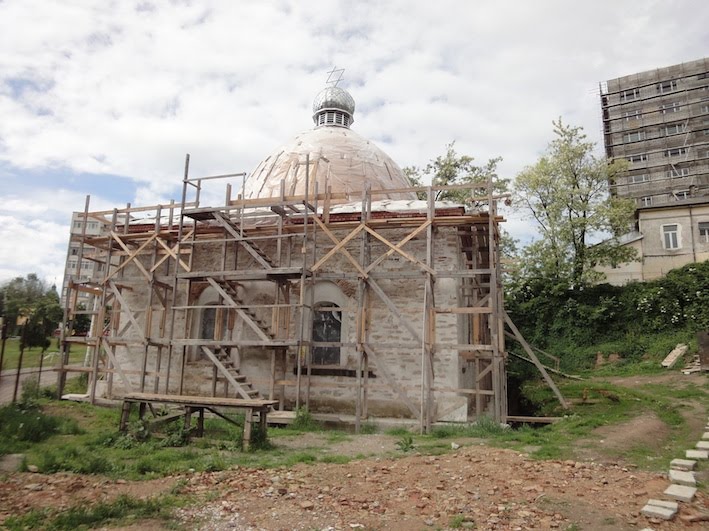
Romania -- Historic synagogue in Iasi under restoration

 Photo (c) Simon Geissbuehler


By Ruth Ellen Gruber

The historic 17th century Great Synagogue in Iasi, in northern Romania, is under restoration. The Swiss historian and diplomat simon Geissbuehler (who has written widely on Jewish heritage in Romania) visited the site last week and provided the picture above. He said the synagogue is empty, and that some work has been completed on the foundations, but that workers on the site did not have a time frame for the work's completion.

The synagogue was built in 1671 and is the oldest surviving synagogue building in Romania. (Before World War II, there were more than 110 synagogus in Iasi alone.) The synagogue has simple lines and tall dome and is set in a small garden, almost totally surrounded by new buildings. Inside, a huge, elaborate Ark, surrounded by frescoes, fills one end of the hall. The former women's gallery for years housed a small exhibit on local Jewish history, organized in the 1980s.

Romania -- Jewish culture festival next week in Timisoara

Just found out about this Jewish Culture Festival, which takes place in Timisoara, Romania next week -- May 24-27.

It is co-sponsored by the local Jewish community as well as the French Cultural Institute and features the internationally known actress Maia Morgenstern (who played Mary in the controversial Mel Gibson movie "The Passion of the Christ.")

Timisoara is a beautiful city, and its Jewish community is one of the largest of Romania's communities outside Bucharest.

Permanent Jewish settlement dates from the mid-16th century, and the oldest tombstone in the  Jewish cemetery is that of a rabbi and surgeon named Azriel Asael, who died in 1636The city's three remaining synagogues include the imposing, Moorish style Citadel Synagogue, designed by the Viennese architect Carol Schuman. It was built in 1864 -- the Austro-Hungarian Emperor Franz Joseph attended a formal dedication ceremony in 1867 and has a monumental façade, with small side steeples and a rose window over the horseshoe-arched entry. The prolific Budapest synagogue architect Lipot Baumhorn designed the so-called Fabrik Synagogue, which was built for the Neolog community in 1899 on Coloniei street. The building was one of Baumhorn's most ornate synagogues, with fanciful domes and carving and a gorgeous interior featuring huge pipe organ beneath scalloped double arches surmounting the lavishly decorated Ark and bimah.When I last saw it, some years ago, it was abandoned and in sorry dilapidated state....

Monday, May 3, 2010

Romania -- Conference in Bucharest

This year's annual Internation Jewish Studies conference at the Goldstein Goren Center at the University of Bucharest will take place May 27-28 and focus on Jews and the City -- on  "how the Jewish minority shaped and was shaped by the urban space along history. The diverse Jewish lifestyles, relations and spirituality patterns, which created a characteristic space within the rich context of urbanism, and their economic expression, artistic values and social ties."

I haven't see the list of speakers yet.

Thursday, December 10, 2009

Romania --Piatra Neamt Wooden Synagogue to be Rededicated


Interior of Piatra Neamt wooden synagogue, 2006. Photo (c) Ruth Ellen Gruber


Interior of Piatra Neamt wooden synagogue, 2006. Photo (c) Ruth Ellen Gruber


Ark in Piatra Neamt wooden synagogue, 2006. Photo (c) Ruth Ellen Gruber


By Ruth Ellen Gruber

The "Baal Shem Tov" or Cathedral wooden synagogue in Piatra Neamt, Romania, will be rededicated Dec. 14 after restoration.


Legend has it that the Ba'al Shem Tov, the founder of Hassidism, prayed here -- that is, on an earlier, masonry synagogue that  stood on the spot, as the wooden synagogue was built, according to documentation, in 1766, and the Ba'al Shem Tov died in 1760.

I've visited on several occasions, the last time in 2006.  This is what I wrote in Jewish Heritage Travel:
The present building is halfway underground, probably built like this to conform to regulations that forbade synagogues from being higher than surrounding Christian buildings. The sanctuary is entered down stairs leading from a little outer prayer room, where regular services are held. Chandeliers hang from the ribbed wooden dome arching over the dull, browny-green walls decorated by pale stenciled flowers. Carved and gilded lions, griffins, bunches of grapes and other decorations ornament the compact but elaborate Aron ha Kodesh, built in 1835 by one Saraga Yitzhak ben Moshe.
Sam Gruber has posted further information and comment on his blog.

The wooden synagogue stands next door to the masonry Great (or Leipziger) synagogue, which was originally built in 1839. It is very similar to other folk-style Moldavian synagogues, with  a small, raised bimah with a trellised frame situated in the middle of the sanctuary in front of a highly elaborate Aron ha Kodesh with tromp l'oeil draperies. The walls are decorated with bright frescoes representing Holy Land themes, and frescoes of biblical animals -- the stag, the lion, the tiger and the eagle -- are painted on the ceiling.


Ark in Great synagogue in Piatra Neamt, 2006. Photo (c) Ruth Ellen Gruber

Saturday, November 7, 2009

Romania -- My Travel Piece in NYTimes online explore painted monasteries and Jewish cemeteries

The International Herald Tribune and NYTimes online runs my travel piece on the Bucovina region of northern Romania -- in which I write about both the painted monasteries and the Jewish cemeteries. The headline writer and photo caption writer unaccounably attributed everything to Gura Humorului, but that is just one of the places I mention in the story -- chosen as the dateline as it is the hub for two monasteries (Voronet and Humor) as well as the historic Jewish cemetery -- I posted a video of the cemetery in September.


November 7, 2009
Where Art and Faith Embrace in Gura Humorului, Romania
 

By RUTH ELLEN GRUBER

GURA HUMORULUI, ROMANIA — The Bucovina region in the far north of the country, wrote the Romanian scholar Silviu Sanie, is “one of those blessed realms where sacred and secular monuments have enriched the enchanting natural landscape. [...]”

Here are Romania’s famous painted monasteries, built in the 15th and 16th centuries when the region, a stronghold of Orthodox Christianity, was threatened by Ottoman invaders.
The vividly colored frescoes on their exterior walls, masterpieces of Byzantine painting, tell the tales of saints and heroes, and portray in epic imagery the cataclysmic struggle between good and evil at the end of days. [...]


Here, too, however, are religious sites far less known and rarely visited that also form important components of the region’s deeply rooted spiritual patrimony. These are the centuries-old Jewish cemeteries, whose weathered tombstones bear extraordinary carvings that meld folk motifs and religious iconography into evocative examples of faith expressed through art.
 Read Full story

Wednesday, November 4, 2009

Romania -- More on Gura Humorului


Photo (c) Ruth Ellen Gruber

By Ruth Ellen Gruber

A few weeks ago, I posted a video that I took of the wonderful and well maintained Jewish cemetery in Gura Humorului, Romania. I was there to document that tombstones of women for my project (Candle)sticks on Stone: Representing the Woman in Jewish Tombstone Art.

I forgot to include the link to the excellent and informative web site about Gura Humorului, which include a map and index of the cemetery. You can find that web site by clicking RIGHT HERE.
In 1857 Gura Humorului had a Jewish population of 190 souls. In that year also the Jewish cemetery was established. That cemetery was active until 1920. In 1920 the "New" cemetery was established right near the "Old" one, and it is still open today. This cemetery (the old and the new) has about 2060 graves. Stones beautifully cared for, many in German. The new part was renovated recently by The Association of Gura - Humora Jewish Community Descendants.

Tuesday, October 6, 2009

Romania -- New Holocaust Monument in Bucharest

By Ruth Ellen Gruber

A new National Holocaust memorial, commemorating Jews and Roma killed in the Shoah, will be dedicated in Bucharest on Thursday.
President Traian Basescu laid the cornerstone for the memorial in 2006 and is expected to attend the dedication. The Romania Ministry of Culture, Religious Affairs and National Heritage described the monument, designed by Peter Jacobi, as "a contemporary expression of a memorial, the bearer of a message, a visible sign, an active space with which the public can interact freely." It includes five sculptures symbolizing Jewish and Roma suffering, a central memorial site and two installations using tombstones.

Construction of the monument was mandated by an international commission on the Holocaust in Romania, headed by Elie Wiesel, which released a 400-page report in 2004. As many as 380,000 Jews, and thousands of Roma, were killed in the Holocaust in Romanian-occupied territories.

Until now, the only Holocaust memorial in Bucharest was one erected by the Jewish community in 1991 in front of the main Choral Synagogue.


Holocaust memorial in front of the Choral Synagogue, Photo (c) Ruth Ellen Gruber

Sam Gruber has posted a detailed article on Holocaust memorials in Romania on his blog.

Saturday, October 3, 2009

Romania -- More on my genealogy travels

By Ruth Ellen Gruber

I posted a lot on this already, but I want to point out that my current Ruthless Cosmopolitan column on JTA deals with my recent trip to Romania with my cousins, on which we dabbled in family history and, as the cliche goes, walked in the footsteps of our ancestors.

RADAUTI, Romania (JTA) -- It's the custom in Judaism to visit the graves of family members around the High Holidays.

This year I went a step further and walked in the footsteps of my ancestors.

My father's parents, who immigrated to the United States before World War I, were born near the market town of Radauti in the Bucovina region of northern Romania.

This is where I went a couple of weeks before Rosh Hashanah. It was my fourth trip to Radauti, which when my grandparents lived there was one of the easternmost towns in the Austro-Hungarian Empire.

My first visit there was more than 30 years ago, in the freezing December of 1978. I was a correspondent for United Press International and was accompanying Romania's then-chief rabbi, Moses Rosen, on his annual Chanukah tour to far-flung remnant communities throughout the country.

I recall visiting 19 Jewish communities in six days. Elderly people in winter coats and astrakhan hats huddled together in unheated synagogues, and puffs of steam came from the mouths of the Jewish choir from Bucharest that came along with us to perform.

My brother Sam also was on that trip, and he and I took time in Radauti to visit the Jewish cemetery and pick our way through the stones to find the grave of our great-grandmother, Ettel Gruber, who died in 1946 and in whose honor I was given my middle name.

Discovering her grave did not trigger in me any further genealogical impulse, though what we experienced on our trip around Romania that week sowed the seeds of my interest in Jewish heritage.

Read full story at jta.org

Wednesday, September 30, 2009

Romania -- My Tablet Magazine article on Candlesticks on Stone

Candlesticks on Stone. Radauti, Romania, September 2009. Photo (c) Ruth Ellen Gruber


Here's the link to my piece in Tablet Magazine about my (Candle)sticks on Stone project, about the representation of women in Jewish tombstone are -- Tablet ran it with a nice slide show of my photos.

It was the first week in September, and in cowboy boots and jeans, camera slung over my shoulder, I crunched through the springy thick tangle of undergrowth that carpets the old Jewish cemetery in Radauti, a market town in the far north of Romania, near the Ukrainian border. Around me stretched the crowded, ragged rows of tilted tombstones: gray and mossy green, some still bearing remnants of the blue and black and red painted decoration that once adorned the exquisite, ornate carving on their faces.

Read on...


I'm about (finally) to start putting up the photo galleries on the project web site.

Monday, September 21, 2009

Romania -- Jewish cemetery in Gura Humorului

By Ruth Ellen Gruber

I've begun to post some YouTube videos of Jewish cemeteries in northern Romania that I am documenting for my (Candle)sticks on Stone project, which examines the way that women are represented in Jewish tombstone art.

The first video is of the cemetery in Gura Humorului, a little town in the heart of the painted monastery country -- two wonderful medieval monasteries, Humor and Voronets, are nearby. To me, the beautiful Jewish tombstones are in perfect harmony with the wonderful paintings on the monastery walls: touriststs visit the monasteries, however, and few people set foot in the cemetery.

Sunday, September 20, 2009

Romania -- Jewish heritage

A disused synagogue in Radauti. Photo (c) Ruth Ellen Gruber

By Ruth Ellen Gruber

My trip to Romania the first week of September coincided with the annual European Day of Jewish Culture -- and I was able to take place in Culture Day events both in Radauti, Romania and in Chernivtsi (Czernowitz) Ukraine. Both events were presentations of the new book by the Swiss diplomat Simon Geissbuehler on Jewish cemeteries in Bucovina -- both sides of the border.

Here is video of my talk in Radauti -- I discuss my own connection to the region but also note the importance of recognizing Jewish heritage and Jewish history, culture and heritage as part of national and local history culture and heritage in general. It's a theme that I have written about frequently and have tried to stress over the years.


Meanwhile, the Federation of Jewish Communities in Romania has issued a statement addressing criticism from some Haredi (strictly orthodox) that they have failed to adequately care for the synagogues, cemeteries and other Jewish sites in their care. FedRom, according to its statement, owns 88 synagogues and 821 Jewish cemeteries. Of these, 34 synagogues and 14 cemeteries are classed as national monuments and thus are acknowledged as part and parcel of the Romanian National Patrimony." Some 638 cemeteries exist in places where no Jews have lived for many years.

The statement outlines the issues and problems. Many of these -- including lack of resources and lack of personnel to take care of numerous sites, and difficulty in finding uses for synagogue buildings in towns were not Jews live -- are common across the region. They were addressed at the Jewish heritage seminar in Bratislava in March, which Romania representatives also attended and which released a statement including recommended good practices and principles in the care and maintenance of Jewish heritage sites.

Here is the text of the Romanian statement:

Lately, some media in Romania and abroad, expressed critical opinions (sometimes, even containing accusations) towards the Federation of Jewish Communities of Romania (FEDROM), regarding the status of the Jewish Sacred Assets in Romania.

Regarding this complex and difficult issue, the leadership of the Federation would like to inform the public opinion about the following:

1.According to the Romanian legislation (Law no. 598 / 2002), the synagogues, Jewish cemeteries and ritual baths (mikvehs) are the rightful property of the Federation of Jewish Communities of Romania. These sacred assets were created with the financial resources of the Jewish population from Romania, who lived for centuries in this area. As such, any private claim is groundless. We would like to emphasize that even the totalitarian regimes of the past recognized this property right of the Jewish communities upon their sacred assets.

2.Currently, according to the FEDROM, we own and take care of 88 synagogues and 821 Jewish cemeteries (13 of which were identified during the last 3 years). From the total number of synagogues, many are located in areas were Jews have not been living anymore for decades. Similarly, 638 cemeteries are located in areas where Jews have not been living for a long time. The majority of the existing synagogues are heavily affected by physical degradation. A number of 34 synagogues and 14 cemeteries are legally classified as historical monuments, thus being acknowledged as part and parcel of the Romanian National Patrimony.

3.The current condition of the cemeteries cannot make us happy, even though, due to all the efforts of FEDROM and of the communities, 119 cemeteries are well-kept and in a good condition, while another 224 are in an acceptable condition. The major issues we face, regarding the cemeteries, are:

» Repairing and replacing fences, including after deterioration and theft;

» Keeping the existing vegetation within normal parameters (weeds, small trees, etc.) This permanently involves land clearing, transporting the cut vegetation out of the area, the use of herbicides and cutting branches – leading to a total expense of approximately 2,432,000 lei (608,000 €) every year;

» The need to repair approximately 73,000 monuments which are broken, tipped over, destroyed by vandals and natural phenomena;

» Guarding the cemeteries, in compliance with the law.

4.The activity of preserving the Jewish Religious Assets requires important financial resources, greatly surpassing the actual means of the Jewish communities of Romania. A few numbers are testifying to this fact:

» In 2007, the Romanian Government allotted 400,000 lei from their budget, for a special program of preservation of the synagogues and Jewish cemeteries in Romania. Between 2005 and 2009, restoration works at the synagogues in Orastie, Piatra Neamt and Iasi (currently in progress) have been carried out, with financing from the Ministry of Culture and Religion.

» Important repair and restoration works for the Choral Temple in Bucharest are undergoing, with a substantial financial contribution of the Bucharest City Hall for the renovation of the façade.

» FEDROM itself has allotted and spent, between 2006 and 2008, over 3,300,000 lei (over 1.1 million dollars), for the preservation of the Jewish Sacred Assets, more specifically for the benefit of 131 synagogues and 145 cemeteries. Due to the current financial crisis, the work volume and resources have dramatically decreased in 2009, a few works already in progress being continued at the Choral Temple in Bucharest, the „Templul Meseriasilor” in Galati and the „Great Synagogue” in Oradea.

The financial resources of FEDROM are, by enlarge, made up of the amounts received from the American Jewish Joint Distribution Committee (USA), the „Caritatea” Foundation and some contribution made by Romanian born Jews.

Unfortunately, due to the current global financial crisis, we received this year less and less contributions from the above mentioned sources, which has a negative impact on our efforts to preserve the Jewish Sacred Assets. Nonetheless, this in by no means due to neglect on behalf of FEDROM and the communities.

5.It is unjust and immoral to expect – in such an absolute way – from the small number of Jews currently living in Romania, without an even remotely encouraging socio-demographic structure, to guard and ensure an impeccable look and functioning of the Jewish Sacred Assets.

On behalf of the Board of Directors of FEDROM

President,

Aurel Vainer, Ph.D.

Wednesday, September 16, 2009

Romania -- Botosani

Botosani. Entrance to old Jewish cemetery. Photo (c) Ruth Ellen Gruber

By Ruth Ellen Gruber

A few months ago, I posted on the desecration of tombstones at the Jewish cemetery in Botosani, Romania. I visited the cemetery last week as part of my (Candle)sticks on Stone project to document the representation of women in Jewish tombstone art in northern Romania's Bucovina region.

The cemetery is vast, and though the newest section is well maintained (and still used by the small Jewish community) the rest of the cemetery is almost inpenetrable.

Photo (c) Ruth Ellen Gruber


It is in the newer section of the cemetery, just on the edge of the overgrown part, that the vandalism took place: a number of smashed and toppled stones still lie there.

Photo (c) Ruth Ellen Gruber

I had wanted to go back to Botosani because I had been so impressed by the distinctive carvings on the (men's) tombstones I had seen three years ago -- vigorous lions, stags and other animals carved in a style that was almost reminiscent of art deco! I had seen a number of these stones in a clearing, down a path from the newer section, and I wanted to see if the same artist/stone mason had also carved candlesticks on women's stones.

This time I found the path, but in three years, weeds, brush, bushes and even saplings have grown up, once again hiding many of the stones that had so impressed me and making it very difficult to take pictures!

Botosani. Photo (c) Ruth Ellen Gruber

I did discover some extremely beautiful and evocative candlesticks -- quite different from those in other towns. But it was so dark and so overgrown that I didn't manage to get the images I had hoped for...Still...

Botosani. Photo (c) Ruth Ellen Gruber
personal, fashion, travel, loan, insurance, health, real estate, home, marketing, personal, fashion, travel, loan, insurance, health, real estate, home, marketing,