Showing posts with label Maros Borsky. Show all posts

Sunday, December 11, 2011

Slovakia -- New Jewish Guidebook

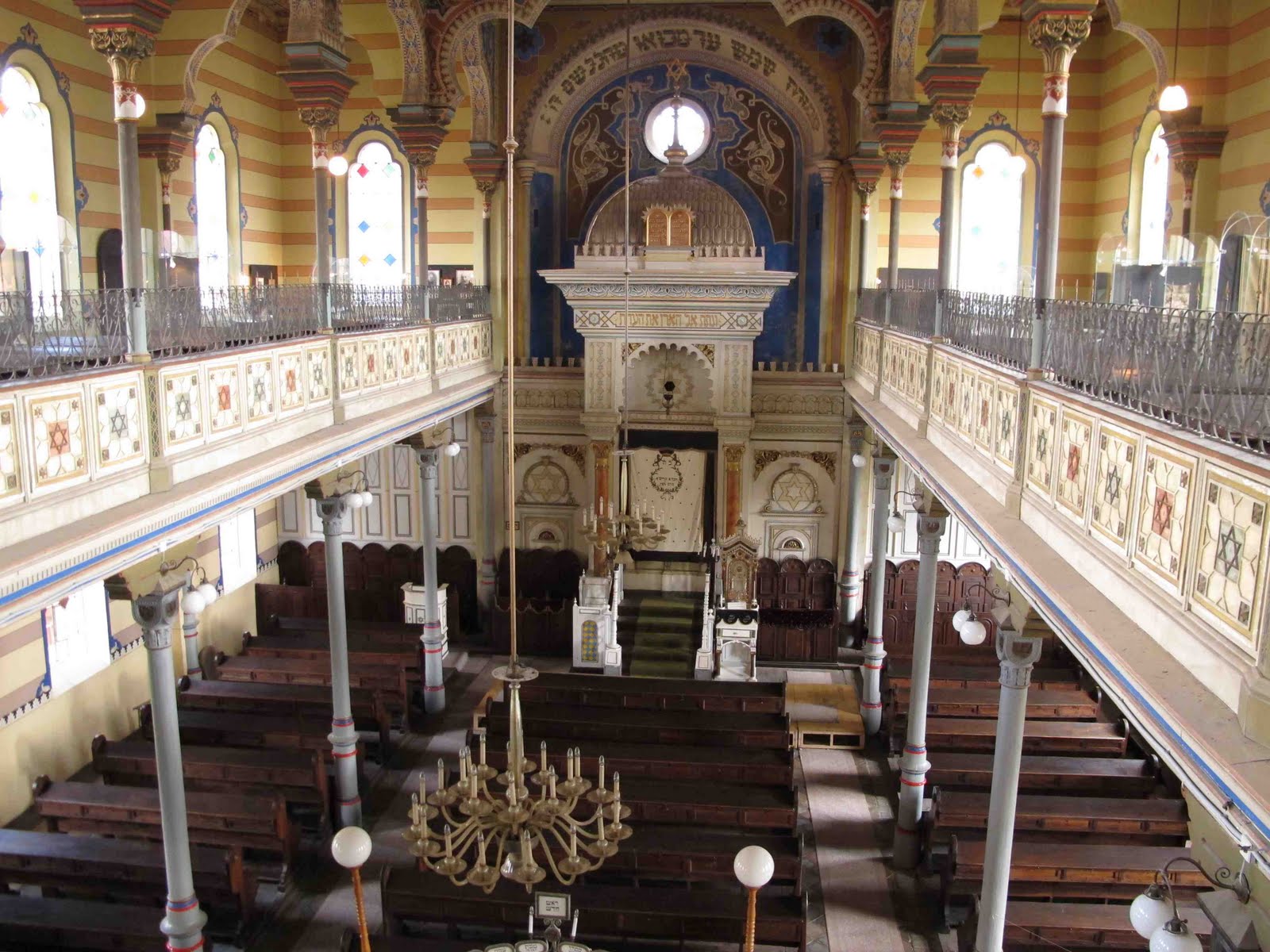
Synagogue in Stupava. Photo (c) Ruth Ellen Gruber

By Ruth Ellen Gruber

Mazel tov to Maros Borsky on the publication of his valuable new bilingual Slovak-English guidebook to Jewish Monuments in western Slovakia. Zidovske pamiatky zapadneho Slovenska/Jewish Monuments of Western Slovakia  was launched last week in Bratislava and Trnava.

A slim paperback illustrated with full-color pictures of each site, the book provides details -- including GPS coordinates -- for Jewish heritage sites in  more than two dozen other towns in Slovak regions of Bratislava and Trnava, giving basic history and current details.

Most of these sites are off the beaten track and not included on the  Slovak Jewish Heritage Route, a network of 25 key sites around the country.

Monday, August 29, 2011

Slovakia -- My Ruthless Cosmopolitan column about Slovakia


In Slovakia, being strategic about preserving Jewish heritage
Maros Borsky, vice president of the Bratislava Jewish community, standing in the Orthodox synagogue in Zilina, Slovakia. The shul is one of the sites on his Slovak Jewish Heritage Route.  (Ruth Elen Gruber)

Maros Borsky, vice president of the Bratislava Jewish community, standing in the Orthodox synagogue in Zilina, Slovakia. The shul is one of the sites on his Slovak Jewish Heritage Route. (Ruth Ellen Gruber)

RUTHLESS COSMOPOLITAN

BRATISLAVA, Slovakia (JTA) -- In 1989, on the eve of the fall of communism, the American poet Jerome Rothenberg published a powerful series of poems called "Khurbn" that dealt with the impact of the Holocaust on Eastern Europe.

In one section, he recorded conversations he had had in Poland with local people who had little recollection of the flourishing pre-war Jewish presence.

"Were there once Jews here?" the poem goes. "Yes, they told us, yes they were sure there were, though there was no one here who could remember. What was a Jew like? they asked.


"No one is certain still if they exist."


I often think of this poem when I travel to far-flung places in Eastern and Central Europe, and it was certainly on my mind on a trip to Slovakia this August.


That's because yes, there are still Jews here, and the post-Communist revival has reinvigorated Jewish communities in the region.


But also, despite this, numbers are still so small that even in many places where Jews once made up large parts of the population, Jewish history and heritage have been, or run the risk of being, forgotten.


"Look," my friend Maros Borsky reminded me in Bratislava. "Kids who were born after 1989 don't even remember communism."


Borsky is trying to do something about this -- which is why I was in Slovakia.


Read the entire story here.

Saturday, August 20, 2011

Slovakia -- Rabbi Andrew Goldstein on Synagogues, Memory and Future


The Goldsteins and Maros Borsky in Samorin synagogue. Photo (c) Ruth Ellen Gruber


By Ruth Ellen Gruber

Rabbi Andrew Goldstein, who was on the recent trip in Slovakia to tour the Slovak Jewish Heritage Route, gave an eloquent sermon this week in his synagogue in London that evoked what we saw -- and raised  important questions regarding surviving sites of Jewish heritage and their place, role and future. These issues have been a continuing focus of this blog, and (of course) of anyone involved in the field. In 2009, a conference in Bratislava was devoted to these issues and formulated a series of "best practices" recommendations to consider when dealing with disused or abandoned Jewish sites.

Rabbi Goldstein is the chairman of the European Union for Progressive Judaism and has spent decades traveling and teaching in east-central Europe.


SLOVAK SYNAGOGUE SERMON

What do you do with a synagogue building that becomes redundant? What do you do if the community shrinks and can no longer support a congregation or the upkeep of the building?

I wonder if our friends at Harrow and Wembley Progressive spent long searching the Talmud to see what were their options: as you know they recently sold their building to a fundamentalist Christian church and moved in with Middlesex New...Reform synagogue. A brief look at the rabbinic sources says you can sell a synagogue if you use the proceeds to build another: which lets Harrow & Wembley off the hook, or for community benefit: which was certainly the case when North London sold their building. The Talmud says you may sell a synagogue on condition that its not going to be turned into a wash-house, a tannery, a bath-house or a toilet. What about a church?

It seems as if once a month you read in the Jewish Chronicle of an English synagogue being closed as its congregation dwindles and a number have become evangelical churches and increasingly mosques. Just think of the famous Brick Lane building that started out as a church, then an ultra-Orthodox synagogue and now a mosque. And I suppose we should recall that NPLS started out by using a former Primitive Methodist church as it first synagogue. The continued use of a redundant building for religious purposes seems appropriate, but often British shuls seem to be turned into blocks of flats or office buildings: at least I have not heard of a tannery or public convenience.

Sharon and I have just returned from a fabulous tour round Slovakia as guests of the Slovak Tourist Board, arranged by our friend Maros Borsky. The idea was to take journalists along the Slovak Jewish Heritage route that Maros has developed. Photographs of which we saw displayed in our Art Gallery a few weeks ago: we visited the actual sites, along with journalists from Israel, Hungary & Italy. The Israelis were all secular, yet seemed genuinely moved by Sharon singing Psalms in the empty shuls we were taken to.

Of course Slovakia is quite different from the UK....because the vast majority of its Jewish population was wiped out in the Holocaust. And of those of who survived, most left the country after the war with its take-over by the Communists or during the brief window of opportunity during the Prague Spring. Since the end of communism the community has dwindled further and those that have stayed have tended to move to the capitol Bratislava that nowadays has the only viable Jewish community in the country.

Unlike neighbouring Poland and Austria and Ukraine, unlike Germany, very few Slovak (or Czech) synagogues were actually destroyed during the Holocaust (sadly one of the few was in Spisske Nova Ves where our Slovak Torah comes from). The Communists, however, destroyed many buildings or used them for, often quite unfitting purposes: Bingo halls, markets, store-rooms: though so far I've not discovered a tannery. The Communists also destroyed the surviving Jewish community; and for all of these reasons there are hundreds of Jewish buildings and cemeteries in places, quite often in large towns, where there is not one living Jew residing.

What is the present day Jewish community to do with this vast number of Jewish sites? It cannot preserve and look after everything. Maros Borsky has persuaded the community leaders to concentrate on just a few buildings and cemeteries of special historic or architectural merit. Places that might have a long-term future, that might give evidence of the former glory of the country's Jewish community. Then Maros came up with the idea of a Slovak Jewish Heritage Route that tourists could follow to experience this treasure trove of Jewish beauty.

This was the route Sharon and I along with the 8 professional journalists followed a week ago.

To justify our trip, we too must attempt to get published articles encouraging others to visit Slovakia and, at least, seek out a few of the buildings on the route, and soon I must get down to write a few articles, so this sermon is a first attempt. Tonight, as a theme, I will answer the question I posed at the beginning: what is a fitting use for a redundant synagogue? For a fitting use is one of Maros' criteria as well as a local body able to guarantee a long term future for the building.

The Route starts in Bratislava where Maros is concentrating in converting the woman's gallery in the only remaining synagogue into an exhibition of Judaica from the collection of the community. Downstairs the sanctuary will remain for High Holyday services, the weekly minyan more comfortable in the small "Winter" synagogue. Presov, in the far east of the country, also has a historic Judaica collection in the gallery, though there is rarely a minyan to davven in, perhaps, the most fabulously decorated of all the shuls in the country. It stands in a compound that contains 3 other former synagogues, now used as office buildings. Further east is Bardeov where a tiny shul, a stieble indeed, is preserved exactly as it was when the last Jews were deported 70 years ago. The Orthodox synagogue in Zilina is also intact, though I was saddened to hear that services don't actually take place there: on Rosh Hashanah the tiny community meet in a nearby hall and reminisce - seemingly nobody to lead even a short service. A small exhibition in the women's section is visited by local school groups, but I was interested in a showcase with a selection of Table Tennis memorabilia: once Zilina the centre of the Jewish game. Trnava has two synagogues: one once Orthodox and Neologue and both have been turned into are galleries. The former expensively repaired with the vividly painted walls & ceiling restored to their former glory. The Neologue made safe, but left to remind visitors of its neglected state, a result of the destruction of its community, a reminder of the Shoah. I'm not sure which is the better state for a redundant synagogue found a new use.


The synagogue in Nitra is used as a concert hall and Sharon and I, on a previous visit, heard a children's concert there. Upstairs is Slovakia's official Holocaust memorial exhibition, and on the stairs a collection of prints of Nitra born Shraga Weil. Perhaps a perfect combination for a beautiful building, restored and looked after by the municipality: a reminder of the fate of its past worshippers and yet regularly used for inspiring music. Please God this will be the eventual fate of the magnificent building in Liptovsky Mikulas where we had one of the most moving experiences of our tour. One of our party, David Sivor had there had his Bar mitzvah, and in the now empty sanctuary recalled the event, and Sharon sang Psalms: the acoustics perfect; for a brief moment a reminder the large community that once worshipped in that place.


The future of the Jewish community in Slovakia is uncertain but, at least, through the inspiration of Maros Borsky, they now have a splendid Heritage Route that will long tell of the glory of the former community. Many other stories I could add, especially about our visit to the cemetery in Spisske nova Ves, our Torah town, where Dr Ruzena Kormasova and her High School students continue to research the history of the town's former Jewish community and look after the cemetery. But how appropriate that I tell my story on an evening where we include in our service the blessing of a baby whose mother, if not Slovak - is Czech. Thank God our congregation is thriving: perhaps it has always been like this in Jewish history: Jewish life in one country declines, but the Jewish people and Judaism lives on in places new.

Rabbi Dr Andrew Goldstein
19th August 2011....19th Av 5771


Wednesday, August 17, 2011

Slovakia -- Yet More from the Jewish Heritage Route: Malacky


Malacky - synagogue and discount supermarket. Photo (c) Ruth Ellen Gruber

By Ruth Ellen Gruber

I've always been very fond of the spritely little synagogue in the town of Malacky, just off the highway north of Bratislava. It's a charming Moorish-style building, built for the town's Neolog (reform/conservative) Jewish community in 1886-87 and designed by Bratislava-born Wilhelm Stiassny, one the leading synagogue architects of the day in central Europe. (Stiassny also designed the Jeruzalemska st. synagogue in Prague and the synagogue in Caslav, CZ).

I visited Malacky  during  my five days this month following the Slovak Route of Jewish Heritage -- a  project  devised by my friend Maros Borsky, the leading expert on Jewish heritage in Slovakia. The author of the book Synagogue Architecture in Slovakia, Maros founded and directs the Slovak Jewish Heritage Center. You can see earlier posts on the trip HERE and HERE and HERE and HERE .

With its cream and orange striped exterior, two bulbous side domes topped with stars of David, horseshoe arches and bright blue and yellow decorative detail, the building looks wonderfully cheery but totally out of place: an exotic holdover from some prior life amid a concrete urban setting of parking lots, a supermarket (the ubiquitous discount "Lidl"), apartment blocks and other modern development.

It is a unique reminder of the destroyed community and its world: indeed, it's really the loveliest building in the town.

I was pleased to see that the local muncipality recognizes this -- we were given souvenir coffee mugs and refrigerator magnets with the synagogue's picture on it. OK, it commercializes the -- burtally destroyed -- past, but it also recognizes it....

The synagogue is now used as an art school, and the sanctuary was cut in half horizontally, to create two floors.

Still, much of the lush interior décor has been preserved in fine condition and almost intact -- though downstairs the Ark, pillars and other decoration are somewhat obscured by the school's clutter.


Malacky -- downstairs in the art school. Photo (c) Ruth Ellen Gruber

The upper floor, used as a concert hall, features a wonderful, ornately carved and painted wooden ceiling, as well as the top part of the ark, with its decorative motif of grape vines.


Malacky -- upstairs detail of ceiling. Photo (c) Ruth Ellen Gruber


Malacky -- the upper part of the Ark. Photo (c) Ruth Ellen Gruber


Click HERE for information about travel and tourism in Slovakia.


Saturday, August 13, 2011

Slovakia -- More highlights from Slovak Jewish Heritage Route -- Presov


Mezuzahs in Barkany Judaica collection. Photo: (c) Ruth Ellen Gruber

By Ruth Ellen Gruber

Here are further highlights from my five days following the Slovak Route of Jewish Heritage -- a  project  devised by my friend Maros Borsky, the leading expert on Jewish heritage in Slovakia. The author of the book Synagogue Architecture in Slovakia, Maros founded and directs the Slovak Jewish Heritage Center. You can see earlier posts on the trip HERE and HERE.

A major stop on the journey was the Presov, in the far east of Slovakia, the country's third largest city.

Here we visited the orthodox Jewish compound, centered on the large and sumptuous orthodox synagogue, built in 1898. It is a wonderfully ornate building -- still used by the tiny Jewish community -- that testifies to the one-time size and prosperity of the community here. The women's gallery houses the wonderful Barkany collected of Judaica that was collected for what was the first Jewish museum in the region, which opened in Presov in the 1920s. Alas, it is a branch of the State-run Museum of Jewish Culture in Bratislava and suffers the same lack of information on the objects. But what is there is really wonderful.


Exterior of Presov orthodox synagogue. Photo (c) Ruth Ellen Gruber


Door into sanctuary. Photo (c) Ruth Ellen Gruber


Presov: Ark and Ceiling. Photo (c) Ruth Ellen Gruber


Sanctuary. Photo (c) Ruth Ellen Gruber


Ceiling near Ark. Photo (c) Ruth Ellen Gruber

Click HERE for information about travel and tourism in Slovakia.

Sunday, August 7, 2011

Slovakia -- Following the Slovak Jewish Heritage Route


Brooding sky over Bratislava's main square. Photo (c) Ruth Ellen Gruber

By Ruth Ellen Gruber

I arrived in Bratislava today, to spend the coming week going around the country on the Slovak Route of Jewish Heritage -- a  project  devised by my friend Maros Borsky, the leading expert on Jewish heritage in Slovakia. The author of the book Synagogue Architecture in Slovakia, Maros founded and directs the Slovak Jewish Heritage Center.

 I have been following the evolution of the Jewish Heritage Route from its very beginning. The Route now includes about 24 sites in all parts of Slovakia -- mainly synagogues and Jewish cemeteries. Each uses a common logo and each has a uniform plaque affixed to it, and each involves a partnership with a local body, such as a municipality, or a school, or local Jewish community, or another organization -- that, as a stakeholder, will work to make sure that the site is maintained and also used for educational purposes.

I have visited most of the sites in the past (and reported on some of them in this blog as well as in Jewish Heritage Travel and other writings).

Today we saw the modernist synagogue on Heydukova street, the only functioning synagogue to survive in the city. It was built in the 1920s for the Orthodox community and designed by Artur Szalatnai-Slatinský. It is a rather stark building, with seven pillars marking the street facade. The interior has some cubist elements and very interesting interior detail, including distinctive hanging lamps and a grille around the bimah that recalls gothic construction.


Photo (c) Ruth Ellen Gruber

Maros showed us the work being done in the women's section, where next year an exhibition of Bratislava Jewry will be installed.

We briefly visited the Museum of Jewish Culture, a branch of the Slovak National Museum that reopened in 2009 following the revamping of its original exhibition, which dated from 1993. Although I wish this institution well, I have to say that today's visit did nothing to dispel the disappointment I felt when I was here about a year ago.  The objects are arranged with little information about their history, provenance or significance. See my post from last September by clicking HERE.

Click HERE for information about travel and tourism in Slovakia.

Friday, October 22, 2010

Slovakia -- Maros Borsky to speak in NYC about Slovak Jewish Heitage Route

Former synagogue in Malacky, Slovakia. Photo (c) Ruth Ellen Gruber

By Ruth Ellen Gruber

My good friend Maros Borsky, the leading expert on Jewish heritage in Slovakia, will be speaking in New York on Nov. 1 at the YIVO Institute for Jewish Research about the Slovak Jewish Heritage Route that he began establishing in 2007.You can find details and make reservations for the talk by clicking HERE.

By now the Route links two dozen sites of Jewish heritage around the country -- from the capital, Bratislava, to Kosice and Bardejov in the far eastern tip of the country. Maros is one of the most serious and engaging people active in this field, and his presentation is sure to be exceptionally interesting.

From the web site:

The Slovak Jewish Heritage Route is a complex project that includes research, educational and promotional activities. It is aimed at advocating preservation of Jewish heritage in Slovakia as well as sustaining this attitude. These activities are to a great extend based on the results of the Synagoga Slovaca documentation project of synagogues, conducted in 2001-2006. The outcome of the survey (architectural plans, photographs, descriptions) is used to create an audience for Jewish culture in Slovakia, shape cultural policies and contribute towards improved site management.

We carry out the following activities to develop the Slovak Jewish Heritage Route:
  • Survey of the yet undocumented built Jewish heritage. In addition to the completed documentation of synagogue architecture, the survey gathers data and photographic documentation on ritual baths, educational and other communal buildings, selected cemeteries and Holocaust memorial sites.
  • The survey data will be included into the web database maintained as free public service at www.slovak-jewish-heritage.org
  • A photographic exhibition on Slovak synagogues is under preparation. It will promote Slovak Jewish heritage in Slovakia and abroad.
  • Selected synagogues and other heritage sites will be soon marked with information plaques. These will create an identity for sites that are of historical importance, architectural value, cultural and tourist interest.
  • Printed promotional material will be produced for important sites.
  • Educational seminars and workshops will inform on the preservation and tourism opportunities of Jewish heritage.
  • Local and international promotional activities will include lectures on Jewish history and culture, and close cooperation with media.

Tuesday, October 6, 2009

Slovakia -- New and Improved Web Site, with Jewish Heritage Route

Jewish cemetery at Beckov, Slovakia, under the Beckov castle. Photo (c) Ruth Ellen Gruber


By Ruth Ellen Gruber

The extremely useful and information-packed Slovak Jewish Heritage web site has been revamped and enlarged to include new information, an interactive map, and material on the individual sites that comprise the Slovak Jewish Heritage Route. (It also includes travel and accommodation information for Slovakia.)

The web site is devised and operated by Maros Borsky, the leading expert on Jewish heritage in Slovakia. The author of the book Synagogue Architecture in Slovakia, Maros founded and directs the Slovak Jewish Heritage Center - one of 36 organizations featured this year in Compass, a new guide designed to introduce, inform and enlighten readers about what it sees as some of Europe’s "most vital, innovative, effective and sustainable Jewish organizations and programs."

Each month, a "site of the month" will be highlighted online -- sites in good condition but also neglected sites that need action to save them. The current "site of the month" is the wonderful synagogue building in Liptovsky Mikulas, a neo-classical structure that was rebuilt by the Budapest architect Lipot Baumhorn after fire damage in 1906. It was in bad shape when I first saw the building in 1990 or 1991; it was later partially restored. Just three years ago, it was being used as an exhibit hall and cultural venue. Today, however, the synagogue (which was restituted back to the Jewish community) has been closed, and it is impossible to visit.

The building, Maros writes on the web site:

embodies the tragedy of Jewish heritage in Slovakia. Although it is one of the most beautiful synagogues in Europe, there is no use for the building, and nobody is willing to come up with a solution for its survival. However, for the time being, it is still worth seeing – at least from the outside.

Synagogue in Liptovsky Mikulas, 2006. Photo (c) Ruth Ellen Gruber


The Slovak Jewish Heritage Web site states:

Our online resources provide information about major Jewish sites around the country. The material covers a range of topics and is oriented to scholars as well to the general public.

The MONUMENTS DATABASE features details on hundreds of Jewish heritage sites we have documented throughout Slovakia. We began our work in 2001 as Synagoga Slovaca, a project aimed at documenting the scores of synagogues, many of them in ruinous condition, that still stand in all corners of the country. We are gradually adding cemeteries, cemetery chapels, mikvaot (ritual baths), school buildings, other Jewish communal buildings and Holocaust memorials. Material in the database includes historical and architectural information as well as photographs.

The SLOVAK JEWISH HERITAGE ROUTE promotes the country's most important Jewish heritage sites and integrates them into national and local cultural, educational and tourism contexts. The Route is associated with the European Routes of Jewish Heritage, which has been declared a Major Cultural Route of the Council of Europe.

These projects and other activities of our Center are part of a long-term vision that includes the establishment of a sustainable and multi-faceted SLOVAK JEWISH HERITAGE PROGRAM. We strongly believe that our work can foster a desire - and a commitment - to seek sustainable frameworks for the maintenance and restoration of these important yet all-too-often neglected heritage sites. Only through such strategies can we contribute to the preservation of Slovak Jewish monuments as part of Slovakia's overall multicultural heritage.


Friday, June 26, 2009

Christian Science Monitor Article on Jewish Heritage

Check out Michael J. Jordan's article in the Christian Science Monitor about the issue of caring for Jewish hertiage in Europe. Michael sat in on some of the sessions at the March seminar on Jewish heritage in Bratislava, but the story runs as an advancer before this weekend's Holocaust Assets conference in Prague.

For architectural historian Maros Borsky, the story begins five years ago.

He was documenting the synagogues of Slovakia, which, like the rest of post-Holocaust Eastern Europe, saw its countryside depopulated of Jews, with most provincial synagogues abandoned. Slovakia itself has seen a war-time community of 137,000 shrink to some 3,000 Jews today, with only five of 100-plus synagogues functioning.

In the course of his work, Mr. Borsky came across a donor who wanted to renovate a rural synagogue. But which one?

"I realized it's important to create an audience for these synagogues, for Jews, non-Jews, locals, and tourists to learn there once was a community here – and what happened to it," he says.

The result of Borsky's work, the "Slovak Jewish Heritage Route" will soon connect 23 restored synagogues.

The Slovak project will be just one of scores discussed this weekend in Prague as representatives from 49 countries convene for the landmark Holocaust-Era Assets Conference. The agenda ranges from charting the progress made in returning Nazi-looted artwork and restituting Jewish property to caring for elderly survivors of the camps.

Read full article

personal, fashion, travel, loan, insurance, health, real estate, home, marketing, personal, fashion, travel, loan, insurance, health, real estate, home, marketing,